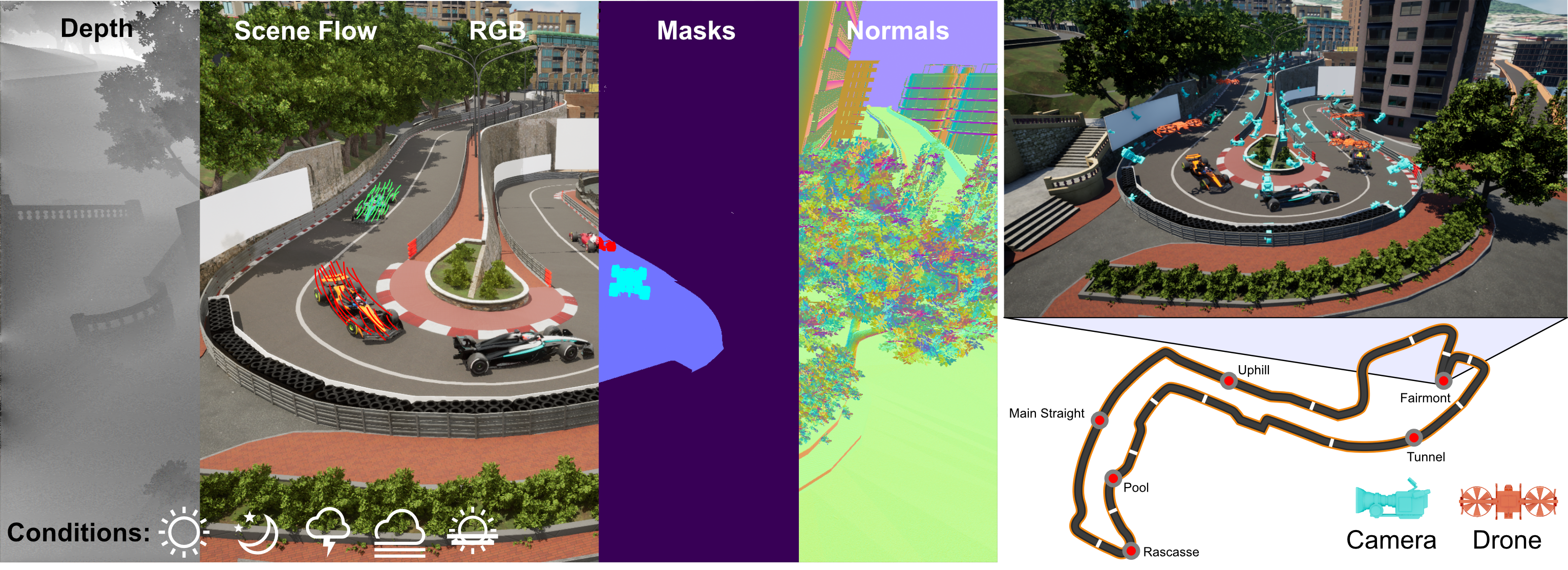
Six sections of a to-scale Monaco Grand Prix replica, rendered in Unreal Engine 5, under five illumination conditions, with dense multi-modal ground truth.
Six sections of a to-scale Monaco Grand Prix replica, rendered in Unreal Engine 5, under five illumination conditions, with dense multi-modal ground truth.
No existing dataset covers the combination needed for immersive watching of F1.
| Outdoor | Exocentric | Multi-modal GT | |
|---|---|---|---|
| Driving datasets | ✓ | ✕ | ✓ |
| Indoor multi-view | ✕ | ✓ | ✕ |
| Sports free-viewpoint | ✕ | ✓ | ✓ |
| Monaco4D | ✓ | ✓ | ✓ |
The rig follows real F1 broadcast coverage rather than a generic camera array.
Most photometric reconstruction methods assume illumination changes slowly across a sequence. Every sequence in Monaco4D is rendered under five conditions, plus in-clip transitions such as tunnels, building shade, and streetlamps, which violate that assumption.
That gives 30 sequence and illumination combinations, before car-count variation.
Every frame includes path-traced RGB, surface normals, metric depth, and per-instance segmentation masks.
A single fixed release cannot cover every use case, so we are also releasing the data engine that renders Monaco4D, for selective data generation. No Unreal Engine experience is required to run it.
Vary circuit zone, weather, camera rig, and traffic density independently.
Fast Deferred rendering for bulk generation, or Path Tracing for high-quality output.
Adjust frame rates, resolution, motion blur, headless mode from the UI.
Auto-exposure and motion blur are explicitly controlled, so sequences are reproducible.
@InProceedings{10.1007/978-3-032-37041-9_15,
  author="Mallick, Saswat Subhajyoti and Cherdchusakulchai, Riu and Ruiz Olle, Marc and Mosella-Montoro, Albert and Ribeiro-Gomes, Jose and Carrasco, Francisco Vicente and De la Torre, Fernando",
  editor="Favaro, Paolo and Kukelova, Zuzana and Maki, Atsuto and Rohrbach, Anna and Schindler, Konrad and Tombari, Federico",
  title="Racing in Volume with Flow Ensembles",
  booktitle="Computer Vision -- ECCV 2026",
  year="2026",
  publisher="Springer Nature Switzerland",
  address="Cham",
  pages="274--292",
  isbn="978-3-032-37041-9"
}